
Heads up: Gumnutly is reader-supported. Some links on this page are, or may become, affiliate links. If you buy through them we may earn a commission, at no extra cost to you. How we make money
Wine might bring people to Margaret River, but it’s the landscape that brings them back. In a single day you can walk a clifftop track above the Indian Ocean, stand in a forest of towering karri, and hear the creaky call of black cockatoos flying overhead.
Here’s how to fit it into one unhurried day, and how to do it in a way that leaves the place as good as you found it.
How we put this together
- Established tracks and places only, managed by the state’s parks agency or official tourism bodies. We link to them for maps, closures and conditions.
- Distances and times are flagged for checking, because trail conditions change. Always check before you set out.
- No touching or feeding wildlife. That’s the law in many places, and it’s always the right thing to do.
- Safety basics are linked to official sources rather than paraphrased from memory.
Before you set out
- Check conditions and closures: Explore Parks WA, run by the Department of Biodiversity, Conservation and Attractions (DBCA), lists alerts on its Leeuwin-Naturaliste National Park page.
- Check fire danger: in the warmer months, check Emergency WA for warnings and total fire bans. Some tracks close on high fire-danger days.
- Fees: entry to Leeuwin-Naturaliste National Park is free. Check each cave, lighthouse and campground’s own official page for any fees.
- Mobile reception is patchy on the coast and in the forest. Tell someone your plans.
- Pack: water, sun protection, layers, sturdy shoes and snacks. See our packing list.
Morning: a section of the Cape to Cape Track
The Cape to Cape Track runs along the coast between Cape Naturaliste Lighthouse in the north and Cape Leeuwin Lighthouse in the south, about 130 kilometres in all. Walkers usually take several days to do it end to end. You don’t need to walk all of it. A morning on one short section gives you clifftops, granite headlands, limestone, and a coast full of wildflowers in season.
Easy options for a half-day: – Near Cape Naturaliste in the north. The section from the lighthouse to Sugarloaf Rock is a 3.4 km sealed path (one way). – Around Prevelly and the river mouth, about a ten-minute drive west of Margaret River township. – Near Hamelin Bay or Cape Leeuwin in the south. Check the Explore Parks WA track page for section distances.
Helpful sources: DBCA’s park pages, and the Friends of the Cape to Cape Track website.
Watch for: loose limestone and cliff edges, king waves on rock platforms (stay well back from the water’s edge), and snakes on warm days. Give them space, and they’ll give you the same. In wildflower season, roughly August to November, look out for blooms along the track.
Whales: keep an eye out to sea. The official visitor site’s whale-watching page covers the season and the best spots.
Midday: picnic and a cave (optional)
Pack a picnic from a local bakery or the farmers’ market and find a spot with a view. If the weather turns, duck into one of the region’s limestone caves along Caves Road. See Margaret River with kids for options.
Afternoon: Boranup Karri Forest
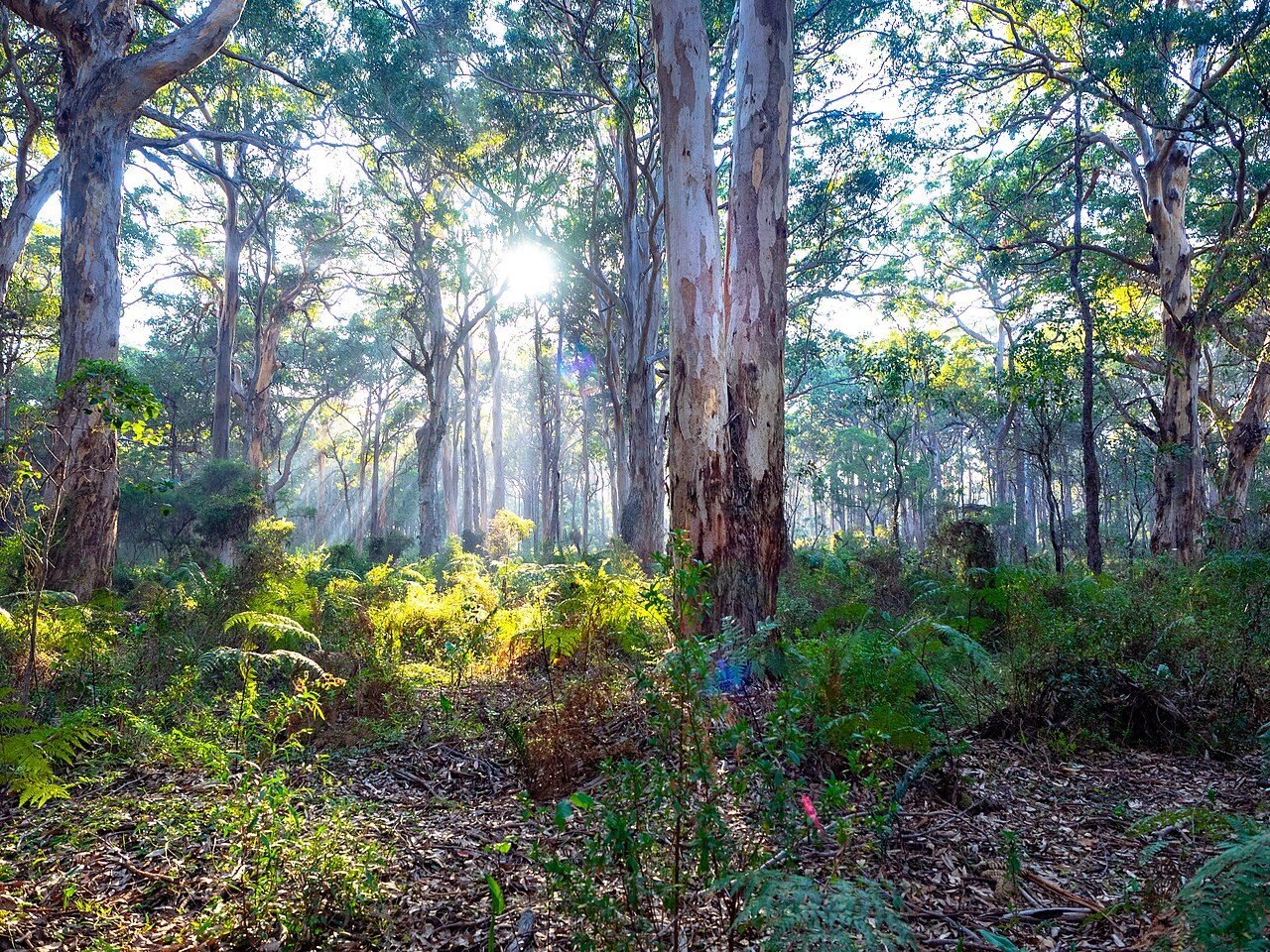
Head south on Caves Road into the Boranup Karri Forest. Karri (Eucalyptus diversicolor) is the tallest tree in Western Australia and one of the tallest in the world, and walking among the straight, pale trunks is very peaceful.
For background on the forest, see DBCA’s Boranup Forest Drive page.
Things to do: – Drive Boranup Drive, a scenic drive through the forest with a hard limestone base that’s suitable for two-wheel-drive cars. Check conditions after rain. – Stop at Boranup Lookout, which you pass on Boranup Drive, for views over the forest. – Take a short walk. Pull in at a picnic area and wander. The light is best in the late afternoon.
Late afternoon: black cockatoos
South West WA is home to three kinds of black cockatoo, and all three are threatened:
- Carnaby’s cockatoo (white-tailed, short bill)
- Baudin’s cockatoo (white-tailed, long bill)
- Forest red-tailed black cockatoo
Under federal environment law, Carnaby’s and Baudin’s cockatoos are listed as endangered and the forest red-tailed black cockatoo as vulnerable. See the federal referral guideline for the three species and BirdLife Australia for more.
Where and how to see them: listen first. Their wailing calls carry a long way. Look in tall marri and jarrah trees, especially where they’re feeding on gumnuts. You’ll often hear the crunch of seed pods before you spot the birds. They can turn up around Margaret River township, in the forest and on farmland.
Be a good neighbour: – Never feed them. – Keep your distance, and don’t play recorded calls. – If you find an injured cockatoo, contact a licensed wildlife carer or DBCA’s Wildcare Helpline on (08) 9474 9055. – If you’d like to help, look up BirdLife Australia‘s black-cockatoo projects, such as the annual Great Cocky Count.
End the day somewhere quiet
After a day outdoors, it’s nice to stay somewhere the bush comes right up to the door. River Reach Chalet is a two-bedroom bush chalet about two minutes’ walk from the river and a short drive from Margaret River town.
Disclosure: River Reach Chalet was previously our founder’s business, and our founder still has a financial interest in it.
It sleeps four, with no pets or parties allowed. Book direct through Margaret River Holiday Houses, or see other options in where to stay in Margaret River.
Leave no trace
- Stay on marked tracks. The coastal heath is fragile, and dieback (a plant disease) spreads on muddy boots. Use boot-cleaning stations where you find them. DBCA says people move Phytophthora dieback further and faster than any other means of spread.
- Take all rubbish home.
- Don’t pick wildflowers, or collect shells, rocks or plants from the national park.
- Leave dogs and other pets at home: DBCA doesn’t permit domestic pets in national parks.
More Margaret River guides
- A Margaret River weekend itinerary
- What to pack for a South West WA bush stay
- Margaret River wineries worth the drive
Written by our editors. Conditions change, so check DBCA and Emergency WA before you go. Last checked: 31 October 2026.